
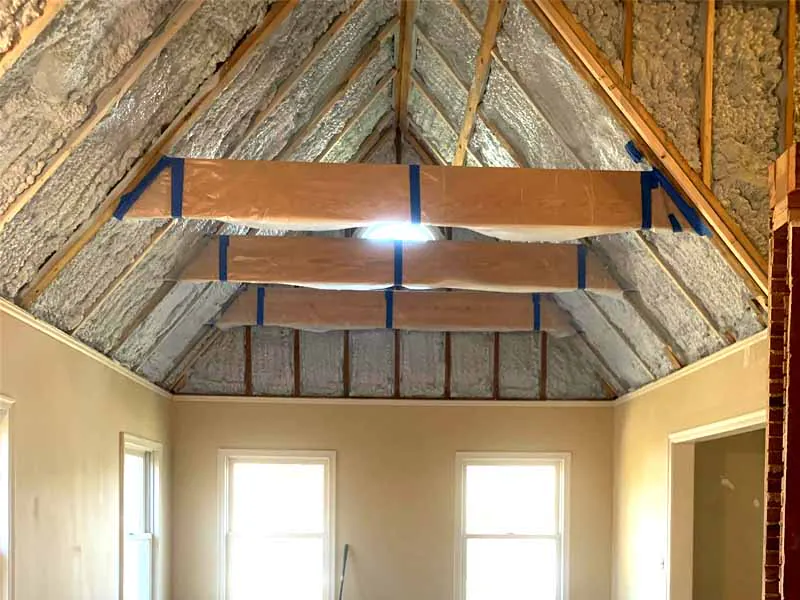
A Kansas City home can feel drafty in January and sticky in July, even with plenty of attic insulation. The issue may not be a lack of R-value, but rather air leaking through gaps, cracks, and cavities.
More insulation won’t fix those leaks. Air leakage is uncontrolled outside air entering the home and differs from ventilation. This distinction helps explain why spray foam insulation may make sense in some parts of a house.
The main advantage of spray foam insulation Kansas City homeowners should consider is its ability to insulate and create an air barrier in the same application. It’s useful when a cavity needs both jobs done at once, not just when someone wants more insulation.
Before choosing a material, it makes sense to find out where the house is leaking. A professional assessment can show whether the project should include air sealing in the attic, rim joists, crawl space, or other areas.
What Spray Foam Insulation Actually Does Differently
It insulates and air seals in one step
Spray polyurethane foam starts as two liquid components mixed on-site during application. Once installed, the foam expands into the cavity.
Unlike batts and loose-fill materials, spray foam is classified as air-impermeable insulation. That’s the advantage of spray foam air sealing: it provides insulation and an air barrier in a single application.
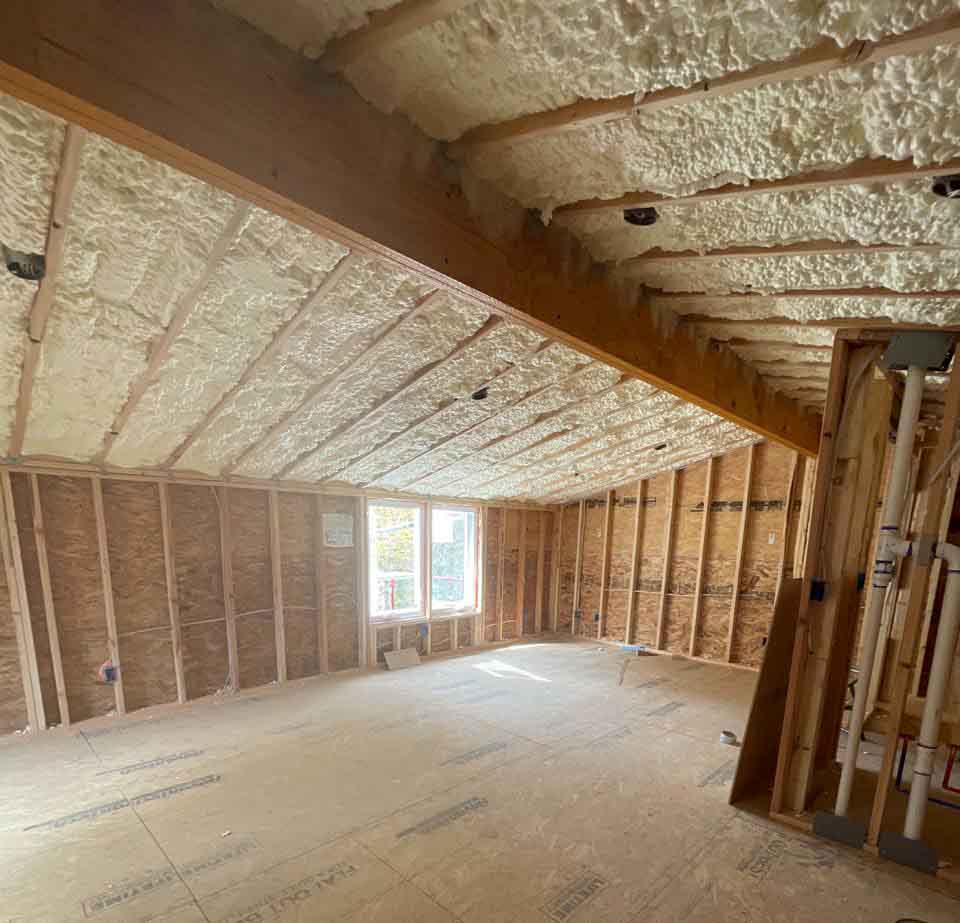
That difference can be especially useful below a roof deck. Foam installed there provides insulation and condensation control as part of the roof assembly. It doesn’t eliminate all air-sealing work, though. Wood-to-wood framing joints still need sealing.
Open cell vs closed cell
Both open-cell and closed-cell foams are polyurethane products. Bio-based, sugar-based, and water-blown foams are also polyurethane.
You can install either open-cell or closed-cell foam on the underside of a roof deck. The choice depends on what the assembly needs to do. In an open cell vs closed cell spray foam decision, use closed-cell foam when you need both air and vapor control.
Foam also doesn’t have to do all the insulating by itself. Some assemblies combine spray foam with batt or blown insulation to reach the target R-value. The right combination depends on the product and the assembly, not a universal R-value-per-inch rule.
What sealing and insulating is worth
Adding insulation alone won’t do much for a leaky attic. Homeowners who seal air leaks and add insulation in attics, floors over crawl spaces, and accessible rim joists could save about 15% on heating and cooling costs. This assumes a 25% reduction in outside air entering the home.
Those savings don’t mean every cavity needs foam. Controlling air leakage can be as useful as adding insulation. When both are needed in the same cavity, spray foam insulation may be one way to handle them together.
Where Spray Foam Earns Its Keep in Kansas City Homes
Our climate zone, at the county level
Kansas City sits on the Missouri–Kansas border, and six surrounding counties share the same climate classification. On the Missouri side, Jackson, Clay, Platte, and Cass Counties fall within IECC Climate Zone 4A, mixed-humid. Johnson and Wyandotte Counties in Kansas do as well. The 2021 county climate data confirms this. Local temperature and moisture conditions help determine how to design an insulation assembly.
Attics with ductwork or HVAC equipment
One place spray foam attic insulation can change the assembly is at the roof line. Insulating the underside of the roof deck brings attic ductwork and the air handler inside the home’s thermal envelope. In a vented attic, that equipment is exposed to larger temperature swings. Insulating at the roofline brings it into a more temperature-controlled space.
Complicated roof geometry
A conventional attic floor isn’t always easy to air seal. Rooflines can include transitions between flat ceilings, tray ceilings, knee walls, and vaulted areas. Those changes create more connections and potential leakage points.
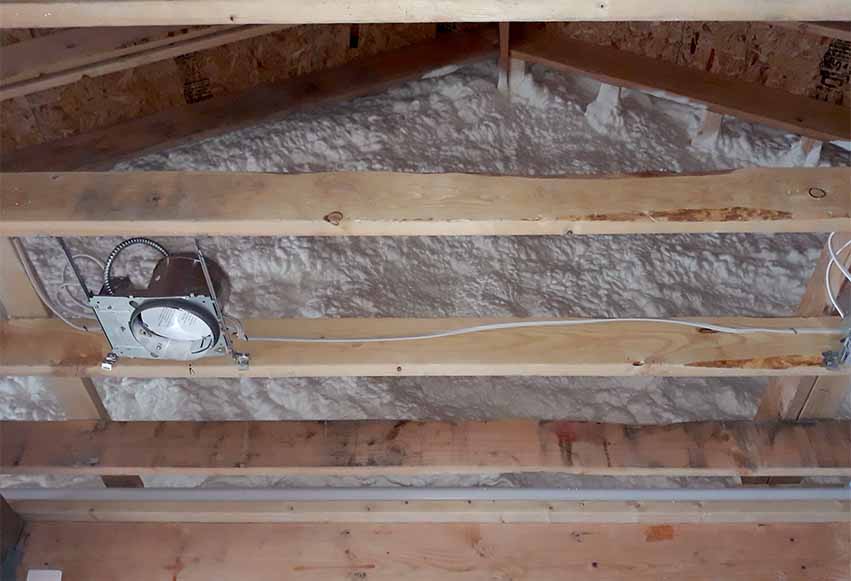
For homes with complicated roof geometry, an unvented conditioned attic may be worth considering. The same applies when the roof is difficult to vent properly. Moving insulation to the roofline can simplify the thermal boundary instead of trying to follow every ceiling transition. Homes with sloped interior spaces may also need a more specific approach to vaulted ceiling insulation.
Low-slope roofs and cold eaves
Low-slope roofs can create another space problem. At the eaves, there may not be enough room for both the required insulation and a ventilation channel.
Thin insulation in that area can contribute to ice damming. That’s one reason it helps to understand the connection between ice dams and attic leakage before choosing an insulation approach.
Crawl spaces and rim joists
Crawl spaces affect more than the area under the floor. Air can move from a crawl space into the living space above, carrying moisture and odors.
A spray foam crawl space application may be part of a larger sealing and encapsulation approach. Sealing the floor and rim area helps control moisture moving upward, while encapsulation can help manage crawl space moisture and mold risk.
The goal is to control the pathways rather than treat the crawl space as separate from the rest of the home. Crawl space encapsulation addresses those conditions as part of the overall assembly.
Fewer openings
Converting an area from vented to unvented also means fewer openings to the exterior. Eliminating vents reduces potential entry points for insects, rodents, and birds. That isn’t the main reason to choose foam, but it can be another practical benefit when the assembly design includes closing vents.
What to Expect — and When Spray Foam Is Not the Answer
Install day
Spray foam insulation safety starts with keeping people out of the work area while the foam is being applied. Occupants, pets, and other trades should leave the building during installation.
Make sure you and your pets are out of the house on installation day. You’ll need to stay away for at least 24 hours, but it can take longer. The foam needs time to cure, and you’ll need to air out the house before you return. Because formulations and curing rates vary, check the product-specific re-entry requirements with your contractor before scheduling the work.
Why installer quality matters
Spray foam is essentially manufactured on the job site. That makes installation quality part of the finished product.
Substrate temperature, moisture content, lift thickness, and the component ratios can all affect the result. When foam goes against a roof deck, the deck must be dry, clean, and free of debris before spraying begins.
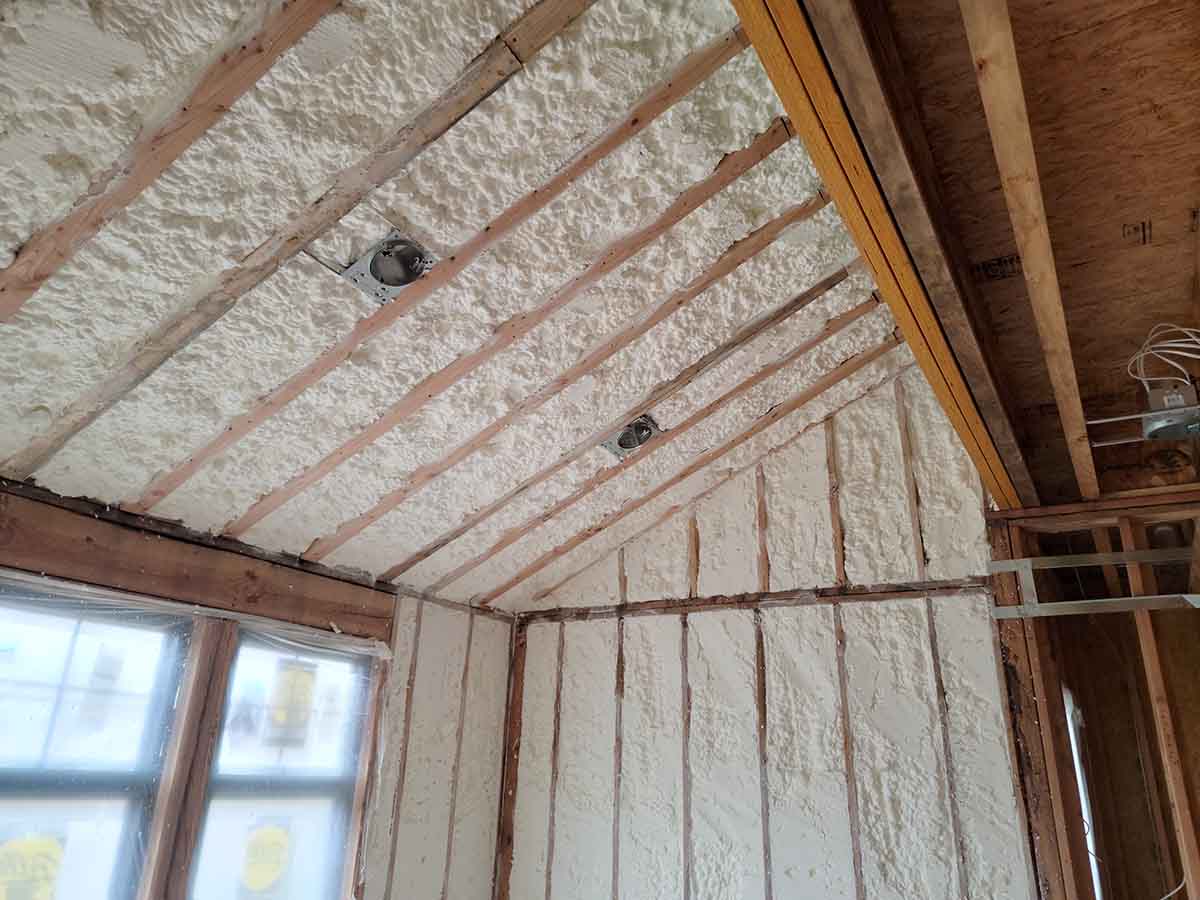
You can’t separate installation from performance with this material. The installer controls key conditions during mixing and application.
Code and assembly details
Spray foam must also fit the rest of the building assembly. Some products require a thermal or ignition barrier, while others do not.
Vapor control needs attention as well. In Climate Zones 1 through 4, a Class I vapor retarder should not be installed on the interior side of the assembly.
Air sealing also changes how the whole house behaves. A tighter home needs controlled mechanical ventilation and combustion-safety checks. Don’t confuse uncontrolled air leakage with proper ventilation; closing random leaks doesn’t remove the need for intentional fresh-air management.
When another material wins
Spray foam isn’t automatically the right material for every attic.
If the roof leaks or is nearing the end of its life, repair or replace it before spraying foam against the roof deck. Insulating a vented attic at the floor makes roof leaks easier to spot and lets the area dry out.
Surface area can also affect the decision. An unvented attic may require 10% to 60% more insulated surface area than a vented attic insulated at the floor.
For a straightforward attic where air sealing can be handled separately, spray foam vs blown-in insulation may come down to what the assembly actually needs. Blown-in insulation at the attic floor is generally faster to install and less expensive.
FAQ
The best insulation choice depends on the assembly, not the marketing claim attached to a particular material. Spray foam makes the strongest case where insulation and air control need to happen in the same place. In another part of the same house, a different material may make more sense.
Leakage location should drive that recommendation. An energy audit can help identify where air is moving before a homeowner commits to an insulation system.
If spray foam seems like the right fit for part of your Kansas City home, contact Hayes Company for an assessment and insulation options that match the space.
References
Antonopoulos, Chrissi, et al. Guide to Determining Climate Zone by County: Building America and IECC 2021 Updates. PNNL-33270, Pacific Northwest National Laboratory, 2022. Building America Solution Center, basc.pnnl.gov/guide-determining-climate-zone-county-data-files. Accessed 12 Oct. 2026.
“Below Deck Spray Foam Insulation for Existing Roofs.” Building America Solution Center, Pacific Northwest National Laboratory, U.S. Department of Energy, basc.pnnl.gov/resource-guides/below-deck-spray-foam-insulation-existing-roofs. Accessed 12 Oct. 2026.
“Vented versus Unvented Attic.” Building America Solution Center, Pacific Northwest National Laboratory, U.S. Department of Energy, basc.pnnl.gov/resource-guides/vented-versus-unvented-attic. Accessed 12 Oct. 2026.
“Methodology for Estimated Energy Savings.” ENERGY STAR, U.S. Environmental Protection Agency, www.energystar.gov/saveathome/seal_insulate/methodology. Accessed 12 Oct. 2026.
“Vacate and Safe Re-Entry Time for Spray Polyurethane Foam Application.” U.S. Environmental Protection Agency, 2 Sept. 2020, archive.epa.gov/epa/saferchoice/vacate-and-safe-re-entry-time-spray-polyurethane-foam-application.html. Accessed 12 Oct. 2026.
“Spray Polyurethane Foam Insulation: Health and Safety Recommendations for Consumers.” U.S. Consumer Product Safety Commission, Nov. 2019, www.cpsc.gov/s3fs-public/Spray-Polyurethane-Foam-Insulation-Health-and-Safety-Recommendations-for-Consumers-2.pdf. Accessed 12 Oct. 2026.