
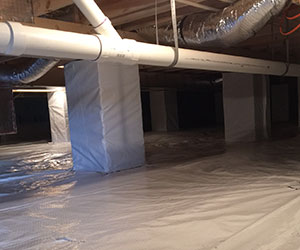
Spring home maintenance in Kansas City usually starts with gutters, grading, and basement checks after heavy rain. The crawl space, if your home has one, often gets skipped.
Many homes around Kansas City have basements or partial basements, not full crawl spaces. But older homes, additions, and mixed foundation homes often still have them. For those that do, that low area matters because moisture problems can move upward, affecting the comfort, energy use, and indoor air quality of Missouri homes.
Spring is the best time to check the crawl space. The extra snowmelt, rain, and rising humidity often make issues of crawl space moisture in Kansas City homes easier to spot. A timely look can help you catch early-stage moisture damage, failed vapor barriers, and compromised insulation. Yet many homeowners don’t know what these things look like, and by the time problems become obvious, they’re expensive to fix.
If you’re unsure what to look for in your crawl space, this guide walks you through the top five areas to check and what to do if you find a problem. A professional crawl space evaluation is also one of the best ways to give you peace of mind by taking the guesswork out of things and catching problems before they reach your floors above.
Why Spring Matters for Kansas City Crawl Spaces
Kansas City is in IECC (International Energy Conservation Code) Climate Zone 4A, a mixed-humid climate. It’s marked by hot, humid summers and cold winters with lots of spring rain. This makes crawl space moisture management a year-round concern, especially with spring’s extra moisture.

In homes with vented crawl spaces or basements, this can be especially problematic because vents can increase moisture rather than remove it. When the warm, moist spring air comes in through the open vents, it hits the cooler framing and condenses on joists, subflooring, and insulation.
There are three spring-specific risk factors for Kansas City homeowners to watch out for:
Snowmelt and spring rain
Poor ground grading or drainage can send spring rain directly to your foundation.
Rising humidity
As outside temperatures and humidity levels climb, moisture transmission through an unprotected dirt crawl space floor also increases.
Freeze-thaw cycling
Winter freeze-thaw cycles create microcracks in foundation walls, allowing moisture to infiltrate during the spring thaw.
Maintaining good moisture control also supports better indoor air quality for your crawl space and home.
Your Spring Crawl Space Inspection Checklist
Use this crawl space inspection checklist as a simple guide. You do not need to be a contractor to notice warning signs, but call a professional if anything looks wet, moldy, damaged, or unsafe.
1. Standing water and drainage
Start with the ground. Look for puddles, damp soil, mud, staining, or a thin film of water on the ground cover.
Then look outside. Downspouts should move water at least 4-6 feet away from the foundation, and the soil should slope away from your house. If water keeps pooling near the foundation, grade correction or interior crawl space drainage solutions for your Kansas City home may be needed before insulation work can be effectively done.
2. Insulation condition
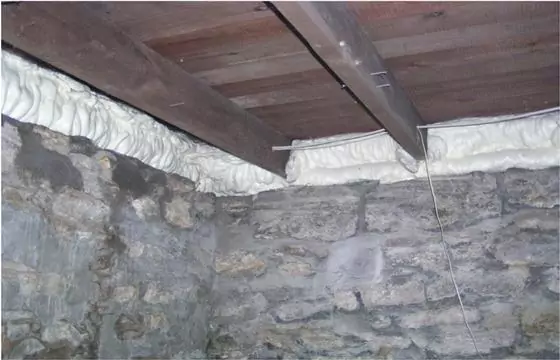
In a vented crawl space or an open basement, insulation is usually installed between the floor joists above the space. Check this insulation above for batts that are sagging, water-stained, wet, missing, or have visible mold. Wet fiberglass does not perform well and should be removed and replaced. That’s where spray foam insulation can help. Spray foam for crawl space insulation is one of the best ways to insulate and air seal at the same time, and help keep out moisture.
For crawl space insulation, knowing the R-value for Climate Zone 4A is important. R-19 of insulation is recommended as a cost-effective floor insulation amount for Zone 4. In a sealed or conditioned crawl space, the approach changes because the foundation walls may be insulated instead.
3. Vapor barrier condition
A plastic vapor barrier on your crawl space floor is the primary defense against moisture rising from the soil into the crawl space air. It’s important that this ground cover system covers the floor completely from wall to wall and is sealed at seams, edges, and piers. Gaps or unsealed edges can negate most of the barrier’s effectiveness.
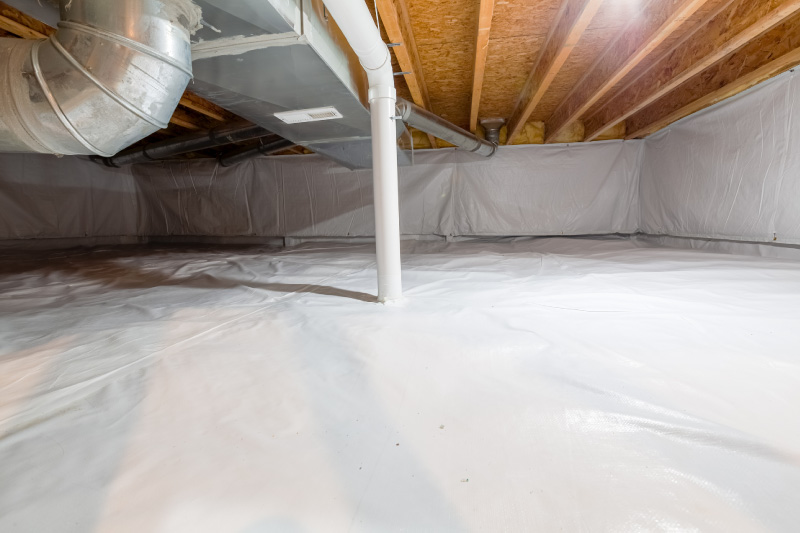
Be on the lookout for torn plastic, open seams, exposed dirt, or places where the barrier has pulled away. If the barrier is damaged or incomplete, talk to a professional about crawl space encapsulation for your Kansas City home to create a more complete sealed system.
4. Wall cracks and pest entry points
Check foundation walls and rim joists for cracks, gaps, and holes. Small gaps can let in moisture, humid air, insects, and rodents. Hairline cracks in poured concrete are common after a winter freeze-thaw cycle here in Kansas City, but cracks wider than a quarter of an inch or horizontal cracks should be evaluated by a professional. Small gaps can also allow radon, a naturally occurring radioactive gas, to seep into your crawl space or basement area.
Air sealing your home’s rim joists is one of the highest impact air sealing opportunities in a Kansas City home. It can help reduce drafts and limit airflow between the crawl space and your home.
5. Wood framing and signs of mold
Look at exposed floor joists, beams, and the underside of the subfloor. Watch for dark staining, soft wood, fuzzy growth, or a musty smell. These are signs that moisture has been hanging around too long.
Sealing and insulating your crawl space reduces energy costs and helps provide crawl space mold prevention Missouri homes need. Take note, if mold is already present, mold remediation must happen before any insulation or encapsulation work can be done.
Vented vs. Conditioned Crawl Spaces: Which is Right for Kansas City Homes?
The conditioned crawl space vs vented crawl space question is an important one. A vented crawl space is designed to dry out moisture by circulating outside air. But in our mixed-humid climate, outside air often brings in more moisture than it removes.
A conditioned, unvented crawl space is sealed, insulated, and treated more like part of the home. The U.S. Department of Energy considers this the best option for homes in humid climates. It’s recommended that the perimeter foundation walls be insulated and a continuous sealed ground cover is also installed in a conditioned crawl space.
If you choose to keep a vented crawl space in your Kansas City home, prioritize:
- Installing or replacing the ground cover vapor barrier.
- Insulate the floor above to at least R-19.
- Sealing the rim joist area against air infiltration.
Frequently Asked Questions
Hayes Company is Your Partner in Crawl Space Protection
Even though your crawl space may be out of sight, it still affects your floors, energy use, air quality, and even your home’s structural integrity. Spring is the ideal time to get ahead of what’s happening below your feet before it becomes a costly repair. An hour-long spring inspection can be the difference between minor maintenance and a major repair bill.
At Hayes Company, we provide insulation and crawl space solutions built around local Kansas City homes. If your crawl space or basement area feels damp, musty, or under-insulated, contact us today. Our Kansas City team inspects for moisture, insulation condition, vapor barrier integrity, and air sealing needs. We’re here to give you a clear picture of what your crawl space needs to perform through the year ahead.
References
ENERGY STAR. “Basement & Crawlspace Air Sealing and Insulating Project.” U.S. Environmental Protection Agency, www.energystar.gov/saveathome/seal_insulate/basement_crawlspace.
ENERGY STAR. “Recommended Home Insulation R-Values.” U.S. Environmental Protection Agency, www.energystar.gov/saveathome/seal_insulate/identify-problems-you-want-fix/diy-checks-inspections/insulation-r-values.
Missouri Department of Natural Resources, Division of Energy. “Energy Codes by Jurisdiction.” State of Missouri, http://dnr.mo.gov/energy/efficiency/codes-jurisdiction.
U.S. Department of Energy. “Building America Top Innovation: Unvented Crawlspace Code Adoption.” Office of Clean Energy Demonstrations, www.energy.gov/cmei/buildings/articles/unvented-crawlspace-code-adoption-building-america-top-innovation.
U.S. Department of Energy. “Insulation.” Energy Saver, www.energy.gov/energysaver/insulation.
U.S. Department of Energy. “Where to Insulate in a Home.” Energy Saver, www.energy.gov/energysaver/where-insulate-home.